Sudoku Puzzles
 |
 |
 |
 |
 |
 |
What is Sudoku?
 Sudoku is a kind of logic puzzle made popular in recent years in Japan and now exploding in popularity across the globe.
Although they look like mathematical puzzles, you don't need any mathematical
skill to solve them. In fact you don't even need arithmetic to solve Sudoku puzzles
- you can solve them by reasoning alone. I think that is what makes them so
interesting and so addictive.
Sudoku is a kind of logic puzzle made popular in recent years in Japan and now exploding in popularity across the globe.
Although they look like mathematical puzzles, you don't need any mathematical
skill to solve them. In fact you don't even need arithmetic to solve Sudoku puzzles
- you can solve them by reasoning alone. I think that is what makes them so
interesting and so addictive.
A standard Sudoku puzzle is a table of 3 by 3 boxes, each of which contains a 3 by 3 array of cells to make a 9 by 9 grid. At the start of the puzzle, some cells are filled with digits and some are empty. To solve a puzzle you must fill in the empty cells according to these restrictions: every row, every column and every 3 by 3 box must contain one instance of the digits 1-9. Each puzzle has a single solution which can be found by a sequence of logical steps from the starting position. You know when you've solved one because all the digits click satisfyingly into place.
You can create and solve puzzles on-line with my Sudoku Puzzle Generator and Workpad.
If you would like some help in solving puzzles, you may like to look at my Sudoku Puzzle Strategy Guide
Me and Sudoku
I was introduced to Sudoku by my wife, who got hooked on the puzzles and could not find enough grids. In January 2005, I wrote her a program to generate new puzzles, and put that program on the web.
 In April 2005 I was approached by the Independent newspaper to supply Sudoku puzzles for their new daily games page. This was the start of
an amazing Sudoku craze, which seems to have taken over every newspaper and magazine in the U.K.
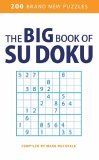
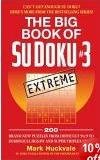
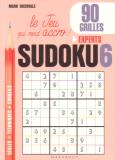
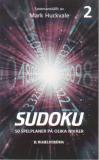
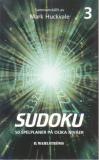
I have seen my puzzles appear in the Scottish Sunday Herald, in the Mail on Sunday, and in Norwegian and Swedish newspapers. Orion Press commissioned a series of puzzle books from me and the Big Book of Sudoku was among the top 50 best selling books in the UK in the summer of 2005 and on the USA Today bestseller list for 9 weeks.
In April 2005 I was approached by the Independent newspaper to supply Sudoku puzzles for their new daily games page. This was the start of
an amazing Sudoku craze, which seems to have taken over every newspaper and magazine in the U.K.
I have seen my puzzles appear in the Scottish Sunday Herald, in the Mail on Sunday, and in Norwegian and Swedish newspapers. Orion Press commissioned a series of puzzle books from me and the Big Book of Sudoku was among the top 50 best selling books in the UK in the summer of 2005 and on the USA Today bestseller list for 9 weeks.
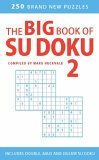
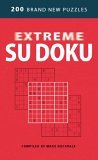
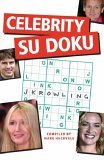
My experience in generating these puzzles allowed me to design a "super" Sudoku puzzle on a 16 by 16 grid for the Saturday edition of the Independent, and a "letter" Sudoku puzzle called "Go Doku" for the Independent on Sunday (Go Doku has letters instead of digits and a surprise name inside each puzzle). I have since created a whole range of sudoku puzzle variants: including the double puzzles and jigsaw puzzles which appeared in 'The Big Book of Sudoku 2' and 'Extreme Sudoku'. For Christmas 2005, I worked with Orion Press to create Celebrity Sudoku, a combination of go doku, cryptic crosswords and wordsearch for new puzzle challenge. More recently I have been working on Kakuro puzzles too.
Sudoku Video
Watch a sudoku puzzle being solved!
For Children ...
You are never too old to enjoy solving Sudoku puzzles, and never too young either!
Here are some little Sudoku puzzle booklets suitable for children:
- Booklet of Mini Sudoku Puzzles (8 puzzles on 4x4 grids) suitable for primary school children aged 7-10. [Answers]
- Booklet of Midi Sudoku Puzzles (8 puzzles on 6x6 grids) suitable for secondary school children aged 11-13. [Answers]
- Pamphlet of Mixed Puzzles (4 puzzles: 4x4, 6x6, easy 9x9 and tricky 9x9) suitable for introducing Sudoku to secondary school children aged 11+. [Answers]
- Leaflet of simple Jigsaw Sudoku puzzles (6 puzzles: 5x5) suitable for ages from 9 to 13. [Answers]
These booklets are copyright free and may be copied for classroom use.
For Enthusiasts ...
And here is a special treat for the Sudoku enthusiast: a Second Booklet of Challenging Sudoku Puzzles - even more challenging!. [Answers]
Puzzle generation
 Although solving Sudoku puzzles is a fun pastime, what attracted me was the challenge of creating new puzzles. A good Sudoku puzzle for me is one which you can solve without guessing, in
a logical sequence of steps from the initial configuration to a unique final solution. There should not be any need to "try out" and "backtrack", nor should there be more than one answer.
I now have software that can create puzzles of specific levels of difficulty (from elementary to diabolical). It can also analyse the puzzles invented by other people. Here are some screen shots. This software is available to publishers under a commercial licence, for more information.
Although solving Sudoku puzzles is a fun pastime, what attracted me was the challenge of creating new puzzles. A good Sudoku puzzle for me is one which you can solve without guessing, in
a logical sequence of steps from the initial configuration to a unique final solution. There should not be any need to "try out" and "backtrack", nor should there be more than one answer.
I now have software that can create puzzles of specific levels of difficulty (from elementary to diabolical). It can also analyse the puzzles invented by other people. Here are some screen shots. This software is available to publishers under a commercial licence, for more information.
The logic behind Sudoku puzzles also lends itself to many variations. Here are some Sudoku puzzle variants I have designed.
On symmetry and seeding
 You will see that many Sudoku puzzles have an initial seeding of numbers
which form a symmetric pattern, whereas most of mine have a rather random
initial configuration. The symmetry that is often used is called 'rotational' symmetry
(the pattern - but not the digits - looks the same if rotated by 180 degrees)
which is also the one used by crosswords. Although my software can generate
symmetric puzzles, on the whole I don't see the point. The symmetry adds nothing
to the logic or the solution, and you might even argue that it is a distraction
in puzzle solving. The analogy with crosswords is not apt, since with a crossword
the solution itself is symmetric. In so doku, it is the seeding that is made symmetric
and as soon as you've entered one digit, that symmetry is lost.
You will see that many Sudoku puzzles have an initial seeding of numbers
which form a symmetric pattern, whereas most of mine have a rather random
initial configuration. The symmetry that is often used is called 'rotational' symmetry
(the pattern - but not the digits - looks the same if rotated by 180 degrees)
which is also the one used by crosswords. Although my software can generate
symmetric puzzles, on the whole I don't see the point. The symmetry adds nothing
to the logic or the solution, and you might even argue that it is a distraction
in puzzle solving. The analogy with crosswords is not apt, since with a crossword
the solution itself is symmetric. In so doku, it is the seeding that is made symmetric
and as soon as you've entered one digit, that symmetry is lost.
Another issue is to do with how many numbers you should start with. Again, I can generate puzzles with varying numbers of seeding digits, but on the whole I don't think it is important. A difficult puzzle doesn't start with fewer digits. You experience this in almost every puzzle when you get to a point in the solution where it is very hard to see where to go even when the puzzle is two-thirds complete! There may be only a few cells left empty, but that doesn't mean the puzzle is now easy to finish.
 |
 |
 |
 |
 |
 |
 |
 |
 |
 |
 |
 |
 |
 |
 |
 |
 |
 |